

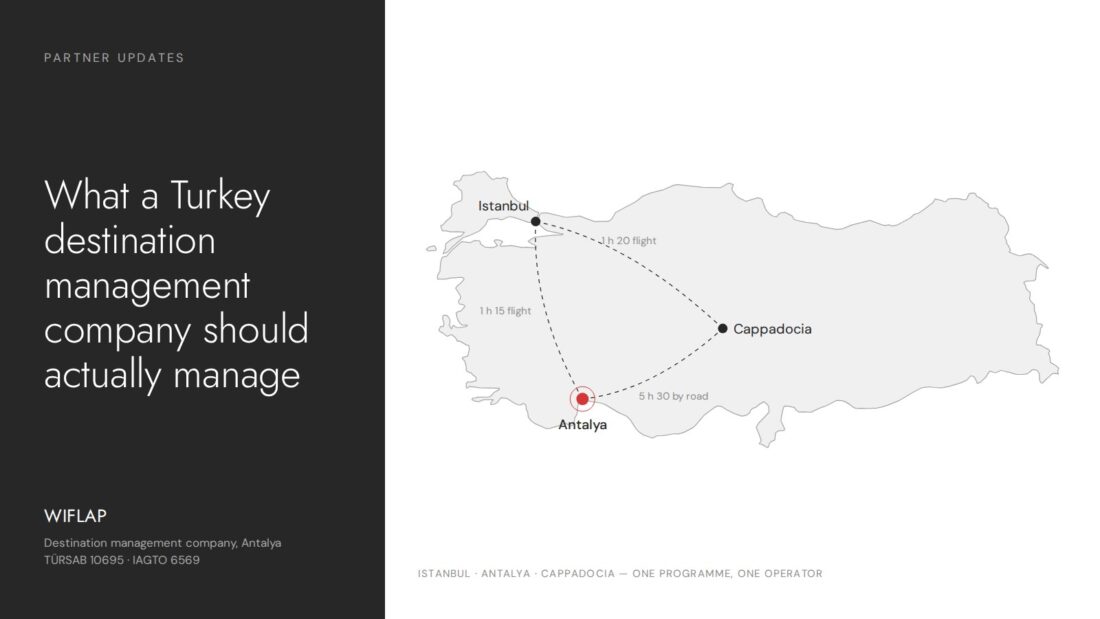
What a Turkey destination management company should actually manage
Rooms in Istanbul, a gala on the Bosphorus, golf in Antalya, transfers and guides look simple on a planning sheet. The value of a local partner shows when flight times move, guests arrive from several countries and a venue needs final numbers.
A programme in Turkey can look straightforward on a planning sheet: rooms in Istanbul, a gala dinner on the Bosphorus, golf in Antalya, transfers, guides, and a few memorable local experiences. The complexity appears when flight times change, guests arrive from several countries, a venue requires final numbers, or a VIP guest needs an immediate adjustment. A capable Turkey destination management company exists to take ownership of those moments, not simply to make reservations.
For corporate buyers, travel trade partners, event planners and private groups, the right local partner turns a long list of suppliers into one accountable relationship. That changes the quality of the guest experience, but it also protects budgets, time and reputation.
What a Turkey destination management company should manage
Destination management is often misunderstood as hotel booking plus airport transfers. Those are essential services, but they are only part of the role. A destination partner should bring the programme together from initial concept to final departure, with a clear view of how every moving part affects the next.
That begins with itinerary design. Turkey offers strikingly different travel environments within one country: Istanbul’s international business energy, Antalya’s resort and golf infrastructure, Cappadocia’s distinctive landscapes, the Aegean coast’s private hospitality, and cultural routes through historic cities. A strong DMC does not force every group into the same itinerary. It matches the destination, pacing, accommodation, venues and experiences to the purpose of the trip.
For a leadership retreat, that may mean a discreet resort, productive meeting space, reliable executive transfers and carefully timed cultural moments. For an incentive group, it may mean a high-impact arrival, a private evening venue, local entertainment and guest support that keeps the schedule moving. For a golf group, course access, tee-time management, equipment requirements, hotel proximity and transfer timing all need to work as one operation.
The best partner also manages the less visible work: supplier confirmations, rooming lists, dietary requirements, multilingual support, contingency planning, payment coordination and real-time communication. Guests may never see this work. They should feel its effect in an experience that is composed, personal and well run.
Why one accountable partner matters
Fragmented supplier management creates risk. A hotel may confirm rooms, a transport provider may confirm vehicles, and an event venue may confirm a dinner, but no individual supplier is responsible for the full guest journey. When schedules overlap or conditions change, the planner can be left coordinating several parties from another country or time zone.
A Turkey destination management company closes that gap. It acts as the operational centre for the programme, connecting hotels, drivers, guides, golf clubs, restaurants, venues, ticket providers and specialist experiences under a single plan. This is particularly valuable when a group includes executives, clients, speakers, sponsors or high-value guests who cannot be asked to absorb operational uncertainty.
One point of contact also improves decision-making. Rather than collecting conflicting answers from separate suppliers, planners receive advice based on the complete programme. If an evening event runs late, the destination partner can assess the impact on transport, venue access, staffing and the following morning’s schedule before recommending the right response.
This level of ownership is not about removing the client from the process. It is about giving the client control without forcing them to manage every local detail. The travel buyer sets the goals, budget parameters, brand expectations and approval process. The DMC translates those requirements into an executable programme.
Choosing the right partner in Turkey
Local presence matters, but it is not the only standard. Turkey is a large and varied destination, and a provider with a broad supplier list is not automatically equipped to manage a complex programme. Ask how the company operates on the ground, who oversees service delivery, and how it handles changes outside business hours.
Look for destination depth, not generic coverage
An experienced local team knows more than landmark names. It understands transfer realities, seasonal demand, venue strengths, regional event regulations, hotel service levels, traffic patterns, guest expectations and the practical differences between destinations.
For example, Antalya is a natural choice for resort-based meetings, golf travel, incentive programmes and winter sun, supported by extensive hotel inventory and well-developed group infrastructure. Istanbul offers outstanding options for conferences, executive meetings, client entertainment and culture-led itineraries, but city traffic and venue access require precise timing. Cappadocia can create an exceptional incentive moment, although weather and flight capacity should shape the programme design.
The right advice may sometimes be to simplify. A more ambitious itinerary is not always a better one if it introduces unnecessary internal flights, long road journeys or rushed guest experiences. A trusted DMC should be willing to explain the trade-off between variety, comfort, budget and operational certainty.
Evaluate supplier relationships and pricing discipline
Competitive pricing is not simply about finding the lowest initial quote. It comes from established purchasing relationships, clear contract knowledge and the ability to compare options without compromising the programme’s purpose. A low hotel rate can lose its value if the property is poorly located for meetings, transfers or golf courses. A cheaper transfer plan can become expensive if it creates delays, extra vehicle movements or a weak first impression.
Ask for transparent options at different service levels. A disciplined destination partner can show where investment will have the greatest guest impact and where costs can be managed more carefully. This may involve selecting the right arrival airport, consolidating transport movements, choosing a venue with included production elements, or securing group terms that offer flexibility if numbers change.
Confirm the service model before arrival
Not every group requires the same level of on-site support. A small executive delegation may need discreet meet-and-greet service, a dedicated driver, hotel coordination and concierge access. A large congress or incentive programme may require multilingual hosts, registration support, transport dispatch, venue management, technical coordination and a visible operations team throughout the stay.
The critical question is whether the provider can scale to the actual requirements. Request clarity on on-site staffing, escalation procedures, guest communication, emergency support, and who has authority to solve an issue immediately. Planning is only half the work. Service quality is proven when the programme is live.
Programmes that benefit most from destination management
Complexity is not measured only by group size. A 12-person board meeting with private aviation, security considerations and confidential scheduling can require more precision than a 100-person leisure group. Likewise, a three-day golf programme can involve several hotel, course, dining and transfer dependencies that deserve specialist attention.
Corporate meetings and conferences benefit from coordinated venue sourcing, accommodation blocks, airport operations, delegate transfers, meeting support, gala dinners and attendee care. Incentive travel requires a stronger emotional dimension, balancing high-quality hospitality with distinctive experiences that reward performance and reflect the host company’s standards.
Golf travel deserves its own operational approach. Tee times, course preferences, handicap expectations, buggy requirements, practice facilities, club transport, caddie arrangements and post-round hospitality need to be synchronised. Antalya’s golf region offers a compelling setting for these programmes, but results depend on detailed coordination rather than course access alone.
Private and VIP travel depends on discretion, speed and personal attention. The guest may want a private guide, a flexible driver, exclusive dining, yacht arrangements, premium hotel benefits, or access to cultural experiences without the friction of public itineraries. Here, the value of an established local network becomes especially clear.
Planning for the moments that do not go to plan
Even excellent planning cannot prevent every disruption. Weather may affect an outdoor event. An inbound flight may arrive late. A delegate may lose luggage. A last-minute guest may need a new room category, an urgent appointment, or a dietary change at a private dinner.
What matters is the response structure. A professional DMC anticipates likely pressure points, maintains backup options and communicates with confidence. It does not wait for a problem to become visible to every guest before acting. This requires experienced local teams, supplier credibility and enough operational authority to make practical decisions quickly.
Clients should discuss contingency planning early, especially for high-profile events, time-sensitive meetings, large arrivals and outdoor experiences. The objective is not to make an itinerary feel overly cautious. It is to build confidence that there is a considered alternative when circumstances change.
The value of a long-term destination partner
The strongest travel programmes improve over time. A destination partner that understands a company’s approval process, audience profile, budget philosophy, service standards and past feedback can plan more efficiently on the next brief. That familiarity reduces administrative effort and creates room for better ideas.
For travel agencies and incentive houses, a dependable Turkish partner also protects client relationships. The local team operates as an extension of the agency, delivering the standards promised to the end customer while providing dependable operational reporting behind the scenes. For corporate teams, it means fewer suppliers to vet, fewer contracts to coordinate and a clearer line of accountability.
WIFLAP combines destination knowledge from Antalya with nationwide operational capability for corporate, golf, leisure, meeting and VIP travel programmes. The focus is not on selling a fixed package. It is on building the right arrangement for the people, objectives and standards behind each journey.
When selecting a partner, begin with the experience you need guests to remember and the risks you cannot afford to carry. The right local team will turn both into a programme that feels considered from the first arrival to the final farewell.
Next step
Send us the brief as it stands, even if dates and numbers are provisional. We will return a first programme outline with venue, hotel and transfer options at two service levels.
Request a programme outline →WIFLAP · TÜRSAB 10695 · IAGTO 6569 · Antalya, Turkey
No Comments